
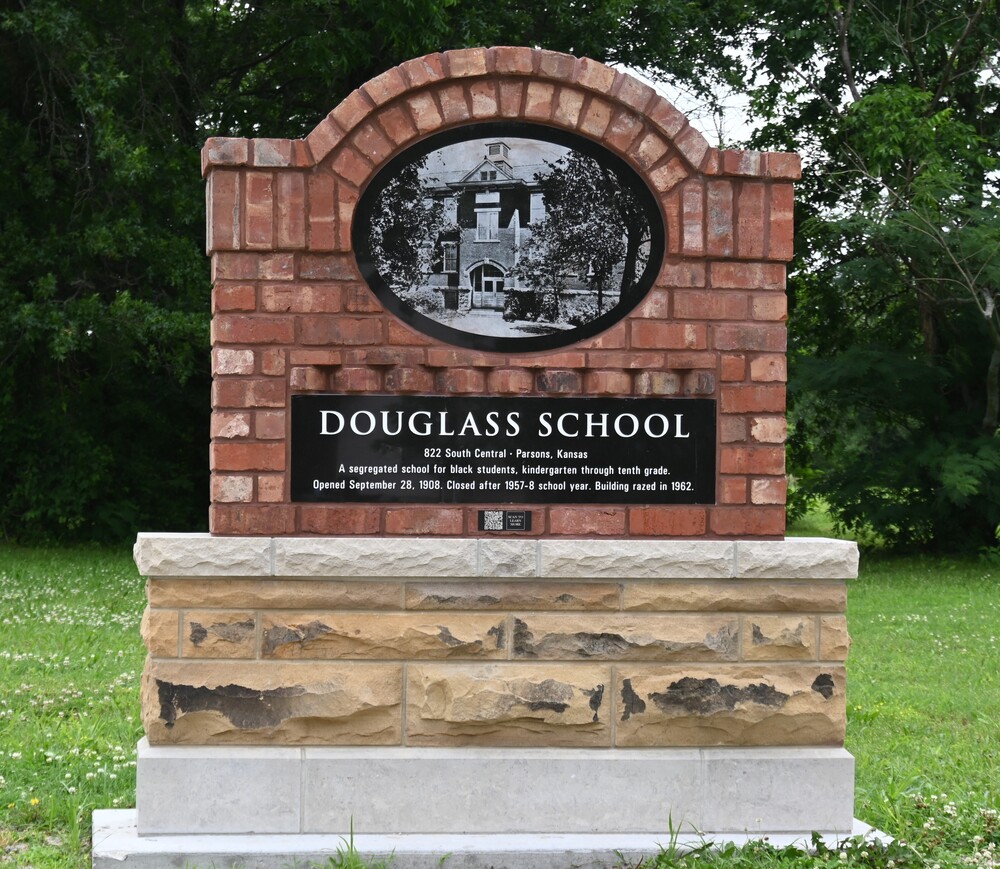
The Parsons Chamber of Commerce held a ribbon cutting ceremony Monday for the new Douglass School Memorial located at 822 S. Central.
Talk has been going on in the community for decades about the need for memorializing Black history in the Parsons community given little of that history was preserved for future generations, but the desire to see something done beyond talk became more earnest for a few residents beginning in 2023.
By June 2024, a small group began requesting the city of Parsons rename Glenwood Park for Frederick Douglass, in memory of the all Black Douglass School which was closed in 1958. The school and property were sold in 1960 to Parsons Industries Inc. and the school was razed in 1962 by the owner.
The name change proposal for the park presented many challenges, put city commissioners in a bind, and some questioned the rationale of renaming the park for a school that was located blocks away and that wasn’t really tied to it. Some brought forward the idea of putting up a plaque or some other kind of memorial in the park that would tell about the school.
USD 503 Board member Lou Martino happened to be in attendance when Sontana Johnson was speaking to the Parsons City Commission about renaming the park. While not in support of the park name change, Martino said he understood what Johnson and others were striving to do.
Martino said there is a lot of great history connected with Douglass School. Just one example is the Watkins family. The superintendent of the district when Douglass School was open, Rees Hughes Sr., hired Levi Watkins Sr. as principal of Douglass School. Watkins had five children, one of whom was Levi Watkins Jr. who became a heart surgeon at Johns Hopkins, and was the first physician to implant an automatic defibrillator into a human patient. He became chief resident of cardiac surgery, acting as the first African American chief resident at the university. His sister, Annie Watkins Garraway, was a philanthropist and mathematician, who earned her master’s from Berkley, and had a successful career at AT&T Labs and Lucent Technologies, where her algorithms and inventions paved the way in telecommunications and electronic transmission of data, according to her family.
“Over the years, as a USD school board member I’ve suggested we memorialize Douglass School by hanging a large bronze plaque with a short history of Douglass School alongside Skip Smith’s drawing of Douglass School and displaying it in a prominent place at PHS. That was my suggestion to the city,” Martino said. The suggestion was not supported.
Johnson returned to the City Commission each time more adamant than ever about changing the name of the park, so Martino tried to come up with other ideas that might present an acceptable solution for both the city and Black residents. Questions arose in his mind as to if Douglass School could be honored in another way, and what, if any, responsibility USD 503 should have in it.
“Reading the oral histories from WSU for Douglass School, listening to Sontana, and listening to the city commissioners, I said really the onus of this whole thing is on the school district. It was the school district, along with the federal government, that decided to close the school because of the 1954 Brown V. Board of Education. It wasn’t desegregated, it was closed, so guess who had to move? The Black kids had to move. So it really wasn’t an equal desegregation. It was kind of one sided,” Martino said.
By stating his personal opinion, Martino said “I wasn’t trying to overstep the boundaries of the other board members.”
However, with close ties to the Black community, Martino said he wanted to seek a solution that would make everyone happy. The former location of the school was near the intersection on Central and Morton, beside the railroad tracks and city walking trail. He felt there was potential for a memorial to be constructed near there honoring the school’s history. His idea was for a large monument, about 6-foot tall, by 4 or 5-foot wide, by about 3-foot deep, made from granite, with a bronze plaque to be erected by the walking trail. Someone could write the history of Douglass School on the plaque. Martino talked to the group, talked to some who had attended the school, and he approached his fellow school board members about USD 503 supporting the project given the historical significance of desegregation and the district’s part in that history.
The school board agreed the district would help support the project. After receiving some initial input on design, Jim Kutz jumped in to provide a drawing of a design for the memorial, Superintendent Lori Perkins took the ball and ran with it to make it a reality.
Martino and Perkins talked to the city about putting a monument up with its approval. It was decided by the city the best location for the memorial would be Appleton and Central, given its proximity to the original school site, but providing greater visibility to the public with high vehicle traffic on Appleton and regular foot traffic on the walking trail.
The city had to relocate some utilities, but made the accommodations.
Parsons city commissioners agreed to contribute $6,500 in tourism money to the $20,000 stone and brick memorial for the former Douglass School. In addition, the Parsons Area Community Foundation provided a grant to Parsons USD 503 for the Douglass School Memorial, for $6,500. Personal and private donations were given as well.
“We found the fifth generation stone mason and he did a beautiful job and we came up with the QR code so people can scan it to learn more about the history of the school,” Martino said. The school district created a website that shares a video of the construction of the memorial from start to finish, history, photos of old school board minutes regarding the Douglass School’s construction through to its demolition, a few newspaper articles and a map.
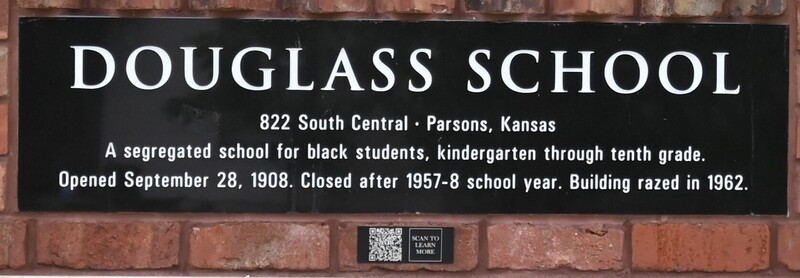
The QR code is attached to the front of the memorial to make it easily accessible to visitors. The QR code is also pictured at the end of this story.
This is the link to the website: https://sites.google.com/vikingnet.net/douglassmemorial/home
Arrangements have been made for the memorial to be lit at some point and Martino said he thinks there are plans for some landscaping around it as well.
“Sometimes when you're in education you want to leave things better than you found them. I don’t want to call it a legacy, but in a way it is. I fight hard for a lot of things to make this community better, to make the kids better, to become a better person myself. I saw this as a personal goal because of my relationship with Harry Coker for 40 years and then Ruby Redmond. I’d go to her house and she’d share all kinds of information about education and what she thought should be done, and then my relationship with Skip Smith and my relationship with the Black community in general. I look back on my old school in Chicago and I can see where they have those strong feelings and when it’s torn down, there is a feeling of hurt and the way it was done, there was a feeling of hurt.” Martino said. “So I’m excited. I’m happy and there is a little bit of sadness in there too when you speak about the history. Some things haven’t changed. That’s the real sad part. There is still prejudice going on and my wife and I always talk about how we just need to be kinder in this world to each other. We’ve got to quit being so judgmental all the time and that’s hard to do. Give a little more grace. Give a little more grace. It gets to be spiritual after a while.”